Functionalizing Nucleic Acids: Synthesis and Purification Strategies for Bioconjugates as Biomaterials
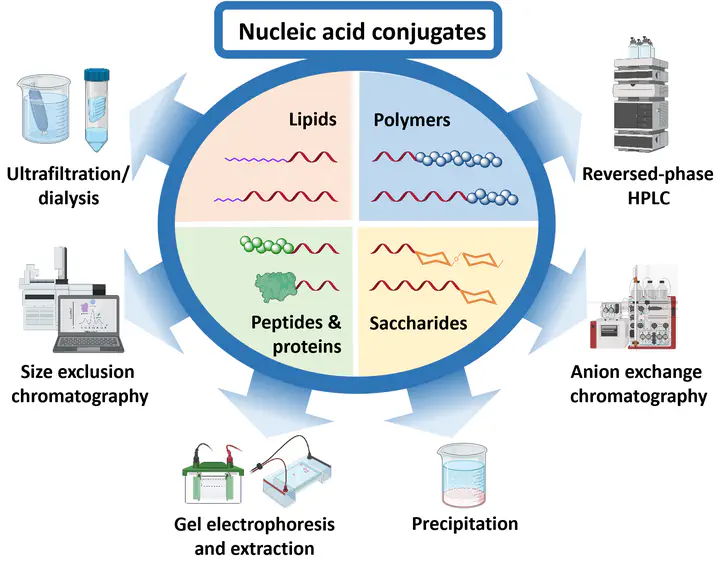 Graphical Abstract: Wiley
Abstract
Nucleic acids are fundamental to life, encoding and storing genetic information, catalyzing biological processes, and directing protein synthesis. The primary classes, DNA and RNA, have become increasingly significant in biomedical applications due to advances in stabilizing these structures against degradation and elucidating their molecular roles. Nucleic acids can be functionalized with polymers, peptides, proteins, lipids, saccharides and other functional units to yield hybrid biomaterials with tailored properties for nanomedicine and materials science. This review summarizes conjugation strategies and provides a critical overview of purification approaches, including chromatographic, membrane-based, and electrophoretic methods, highlighting their principles, advantages, and limitations. Emphasis is placed on the relationship between synthesis route and purification choice, as well as common challenges such as solubility, aggregation, and incomplete coupling. Broadly applicable strategies for the successful synthesis and purification of nucleic acid conjugates are discussed, along with an overview of recent approaches for conjugates with polymers, peptides, proteins, lipids and saccharides. Finally, strategies are summarized for obtaining high-purity conjugates suitable for biomedical and materials applications.

Torsten John
Assistant Professor of Physical Chemistry
We are committed to advancing the understanding of biomolecular behavior and leveraging this knowledge to engineer bionanomaterials.